Time Perspective Network is looking for a case

We are a bunch of scientists who study time, we know a whole lot about waiting time, user experience of time, time across cultures, sustainability behaviors, teams and groups, and how they evolve in time, the vision and future scenarios, we apply temporal research in strategic innovation , designing apps that help to cope with chronic diseases, preventing suicide – maybe you have a case for us to work on during our Conference in Copenhagen this August?

We are in it together with local engineers, members of IDA – so it’s an interesting mix of people – psychologists and engineers and a bunch of artists as well! Please keep us busy!

We want to work on something challenging, interesting and useful! Know some one we should talk to? Please get in touch!

eventora_header

A few thoughts on open access and open science

I have recently stumbled upon this article by Simon Oxenham: Meet the Robin Hood of Science

We should all think before publishing papers:

“Researchers and universities don’t earn a single penny from the fees charged by publishers such as Elsevier for accepting their work, while Elsevier has an annual income over a billion U.S. dollars. Elbakyan explains: “I would also like to mention that Elsevier is not a creator of these papers. All papers on their website are written by researchers, and researchers do not receive money from what Elsevier collects. That is very different from the music or movie industry, where creators receive money from each copy sold. But the economics of research papers is very different. Authors of these papers do not receive money. Why would they send their work to Elsevier then? They feel pressured to do this, because Elsevier is an owner of so-called “high-impact” journals. If a researcher wants to be recognized, make a career — he or she needs to have publications in such journals.”

Inspiration: Eduardo Chillida

I have stumbled upon Marion Deuchars’ Draw Paint Print like the Great Artists in Glyptoteket’s book shop I believe. I really liked it since from the quick look it had a variety of different techniques in it. And I’ve been exploring the book and the artists featured in it since then.

This time I was completely absorbed by a whole new world that has opened up for me – the world of Eduardo Chillida (1924-2002). I must say that I can’t remember if I heard anything about him until now, I probably had, but it didn’t really stay in my memory. I am very thankful to Marion for including this artist in her book! Not only I had loads of fun first coloring the proposed shapes in the book and later trying out my own cut outs, but also I was mesmerized by Eduardo’s work.

Here are a few examples, but a simple google search will reveal a whole new universe.

I’ve read what I could find on internet about him. A Spanish Basque and mostly known for his monumental sculptures. I will explore what the local library has to offer to get to know more about him and his work. From a very quick look I was struck by two of his projects in particular.

The Basque Liberties Plaza, Vitoria-Gasteiz, Araba, Spain – I would really like to go there and experience it.

Monument to Tolerance, Fuerteventura

Made by Arup in Mount Tindaya on Fuerteventura, one of the Canary Islands. From the photos I’ve found I somehow started to think about the Fifth Element movie… It definitely goes on my “wish-to-visit” list. Although I’m not sure if the island itself has any authentic places left or it is all devastated by the tourist industry…

Just returning from the study tour with DIS students to Berlin made me very aware of the effects architecture can have. And “Chillida’s original idea was for visitors to experience the immensity of the space” made me very curious about this piece.

The wikipedia also mentions an interesting encounter between Chillida and Heidegger: “Heidegger wrote: “We would have to learn to recognize that things themselves are places and do not merely belong to a place,” and that sculpture is thereby “…the embodiment of places.”

277N09157_7D5LG

I was hoping to find some kind trace of this dialogue in print. However, not much is available in English. There is the original book in German and actually a translation of it in Danish. I’ll look around more, maybe I can find it in in some other language that I know better, but for now it goes into my “to read” list.

Here are some of my exercises on the Eduardo Chillida theme:

I’m currently reading Saramago’s The Cave and am trying to imagine the Center that he describes in the book and I think my further cutouts are really somehow intertwined with the book..

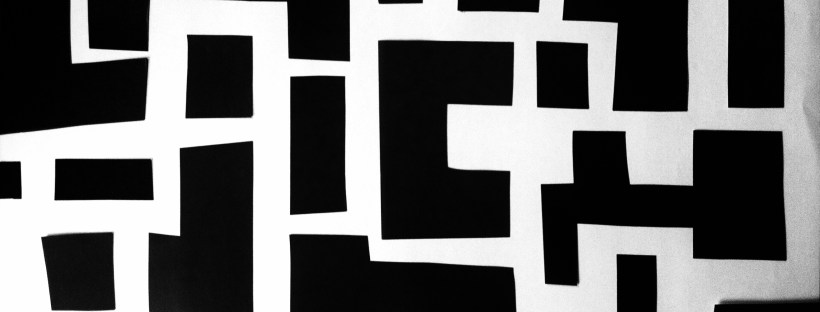
Then I tried to explore how Chillida was working more with the white space:
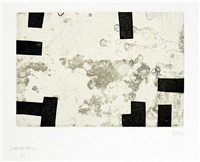
eduardo-chillida-enparantza-i

and here is my take on it:

IMG_2873

but it was somehow difficult for me, then I rearranged the cutouts and spontaneously this version came out, which I still don’t know how it should be – vertical or horizontal..

IMG_2879 (1)


IMG_2879 (2)


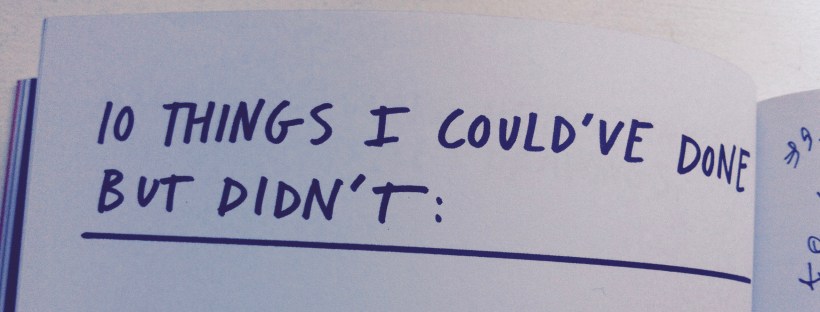
“10 things I could’ve done, but didn’t” or what to do with the self-blame

During the last session of Creative Rendezvous I included a prompt from Austin Kleon’s “Steal Like an Artist Journal”: “10 things I could’ve done, but didn’t”. My own immediate reaction was that I couldn’t come up with what to write, and managed to list three things. During our discussion, it became evident that actually this prompt can easily move into self-blame and regrets domain. This got me thinking what would be a more constructive approach instead?

Eventually I managed to complete the list and after analyzing the answers I came up with the following strategy how to deal with it, how to prevent self-blame and have a more positive outlook when evaluating the answers.

Divide your answers into four groups:

1. To celebrate – maybe it was actually good for you that some things on your list did not happen. For example, if you’re working on quitting smoking, then saying “I could’ve smoked a cigarette last night after that beer, but didn’t” is great, it’s an achievement – celebrate that, compliment yourself on it!

2. Still to celebrate (+/-) – the outcome generally is more on the positive side. For example, “I could’ve spend more time and finalize the article, but instead I went to bed early” or “Could’ve taken more photos during the session, but got totally engaged in the moment and forgot”. The issues mentioned in the “I could’ve done” part are “nice to have”, but overall outcome is still positive. The “didn’t” part has a positive quality to it, something positive, energizing, valuable happened instead. The “nice to have” part can be looked into further – is it something that you should work on or it’s ok as it is?

3. To act on – a group of issues that you would like to act upon, for example “I could’ve done more yoga”, “I could’ve listened to those classes I bought on Creative Live” and there is no continuation to it, there was nothing else with the positive outcome that you did instead. First of all, see how many of those you have in relation to the previous groups. Then weigh them. Do those things bring you closer to your dream, to your “true north”? Ask a follow up question: “If I spend some time doing this next week, will it bring me closer to my dream?” If it will, then that’s an item to act upon. And if not – it goes to the last group:

4. Not to pay attention to.

If still not sure where to start and which issue to choose to work with, then answer these questions for each item (inspired by one of the exercises in Julia Cameron’s book “Way of Artist”):

– Does it cost money or is it free?
– Expensive or cheap?
– Alone or with somebody?
– Job related?
– Physical risk?
– Fast-paced or slow?
– Mind, body, or spiritual?

This should help to make a decision – which is the issue that you would like to act on in the nearest future. Evaluate your calendar – how often can it happen, when exactly?

Schedule it in, make it happen and enjoy it!

Academic writing: Introduction and Discussion

In most cases when I evaluate student’s papers or when I supervised my MA and PhD students, the two most common challenges are with the Introduction section or Discussion.

Academic writing: Introduction and Discussion

There are tons of useful information available on the internet about how to write the different parts of an academic paper. Recently I stumbled upon one, which I really liked, especially the short version of it:

The Sections of the Paper

 Experimental process  Section of Paper
What did I do in a nutshell?  Abstract
 What is the problem? Introduction
 How did I solve the problem?  Materials and Methods
 What did I find out?  Results
 What does it mean?  Discussion
 Who helped me out?  Acknowledgments (optional)
 Whose work did I refer to?  Literature Cited
 Extra Information Appendices (optional)

See the full guide here. Unfortunately I didn’t find who the authors were. And on another note, although this guide is from the biology department and they claim that in humanities papers are very different and it might be so. However, in social sciences we follow the same structure when writing papers (we really really try to be scientific, but I have my doubts).

Temporal Matters Salon

This has been an exciting collaboration so far – between me, representing the International Time Perspective Network and the Celebrating Time, 3rd International Conference on Time Perspective and Creative Roots: Collective Urbanism.

For most part, very outside my comfort zone, but that is why I ventured on this adventure – to explore where and how the psychological theories about time and urbanism issues intersect.

So far we held two Salons at the Cafe Ved Buen. One talk was dedicated to Pace of Life and the other one – to chronotope. The more I read about the chronotope, the more I was getting inspired by this concept and its possible applications outside the literary studies.

You can see my prezi’s from both of the occasions and you’re most welcome to drop by next time! See the schedule and sign up on Eventbrite.

Temporal Matters Salon #1: Pace of Life

Temporal Matters Salon #2: Chronotope: the time-space

Temporal Matters Salon

Creative Rendezvous – February 21, 2016 | Copenhagen

Creative rendezvous – it is the time for you!

It’s time to get together with your inner creative and a few other like minded people and do something fun and inspiring.
It’s time to discover some of your hidden talents, get in touch with your inner Kandinsky or maybe Hemingway..

It’s time to get into the creative flow and extend the present moment.
It’s time to break free from some of the boundaries we tend to create for ourselves and discover new opportunities.

It’s time to take a break, breathe, be with yourself and dissolve in your dreams and then continue with new energy and focus.
It’s time to create and discover!
It’s time to stop waiting for the muse, we’ll start without her, but she’ll join us anyways!


Price: 300 DKK
Art supplies, tea / coffee, snacks are provided.

Places are limited. Please book a spot with 50 DKK via eventbrite:

IMG_2555

Reading Brassaï about Henry Miller

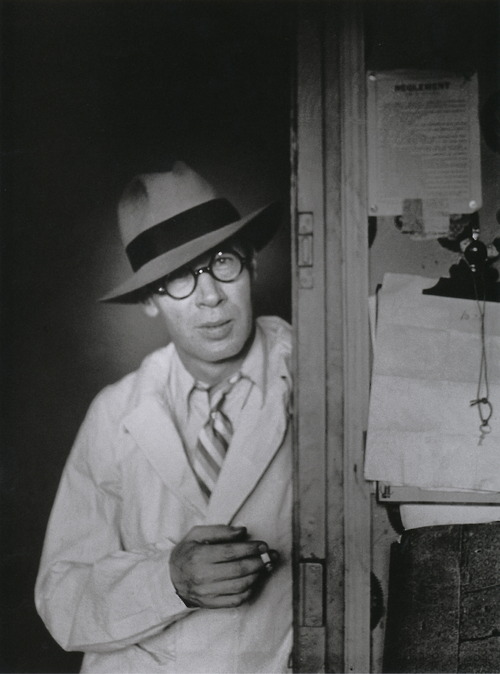
While reading “Henry Miller: The Paris Years” by Brassaï I made a few discoveries about Miller, but also about Anais Nin and Brassaï him-self.

Henry Miller by Brassaï

Henry Miller by Brassaï

Revived my interest in the surrealist movement. Currently am looking into finding their essays about the automatic writing and such. But it is amazing what an impact the psychoanalysis had! The power of dreams that became legit in all the different forms of arts — literature, visual and performance arts. At same time it is not really measurable by the impact factor of scientific journals at all! Some of the ideas just go through and nowadays it is even hard to trace their origin and put a tag on it.

I discovered also that most of Miller’s novels are not as autobiographical as I thought earlier — it’s just he had a very strong power of imagination and sometimes couldn’t even distinguish between reality and fiction or dream. “…like the Surrealists and the Dadaists, Henry believed that the dreams provided fertile soil for writing, and that the writing did involve the struggle to bring to the surface that which was unknown, hidden, and unrealized” (p. 155). I’ll have to also look up his work “Into the Night Life” which he thought was like the Surrealists were doing.

So much like Brassaï “I live in what I see and hear” and Miller’s “treasures are buried deep within yourself, deep within the bowels of your inner self, and from them you can bring forth copper, or silver, or gold”. I am all about the details which have to match somehow. Scrupulous and pedantic… and so is my art, well, most of it.. Funny fact is both Brassaï and me were born on September 9th.

quote from Brassai

I have also discovered that some of Miller’s prose can actually be read as poetry and it makes a lot of sense. And I am curious to reread his books in English now.

I was hoping that the book will have more photos by Brassaï in it, his nocturnal Paris. But I ordered a few from the library to complement the reading with some visuals. A journey to Paris that doesn’t exist any more. Likewise Istanbul depicted by Orhan Pamuk and Ara Güler. Somehow these poetic city journeys are very interesting for me. Like many other people, I love to walk the city. To see where the feet will take me. What discoveries I will make on my journey.

I wish there was a similar book about Riga. There are so many different interesting corners in my hometown. Every time I go back there, I want to document every street of it. Every story that those streets have…

Books in my life