Информация для тех, кто ищет ключи к русской версии методики Зимбардо по временной перспективе:
Информация для тех, кто ищет ключи к русской версии методики Зимбардо по временной перспективе:

Some random ideas and thoughts I got from participating in a debate hosted at the Suitable for Business 2013 conference (Copenhagen, Denmark). The debate was between Kim Brinckmann (from the Ministry of Science, Innovation and Higher Education), Hanne Leth Andersen (Pro-rector of Roskilde University), Morten Kold (creative director at the agency 2+1) and Rasmus Brygger (National president of a Danish youth party) and moderated by Thomas Buch-Andersen (Danmark Radio).
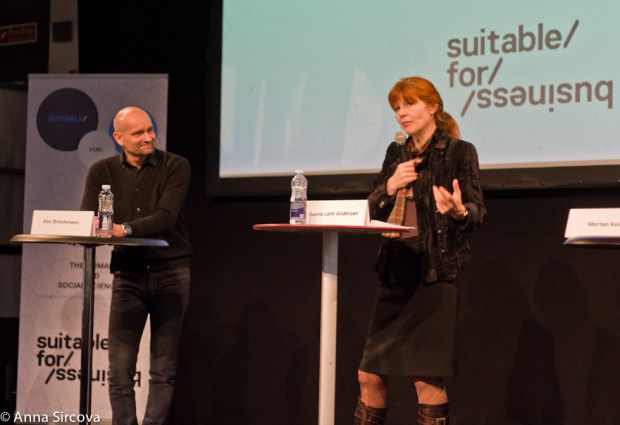
Kim Brinckmann (from the Ministry of Science, Innovation and Higher Education), Hanne Leth Andersen (Pro-rector of Roskilde University) at the Suitable for Business 2013
The discussion was sparkled by the report presented by Kim Brinckmann. Here you can find all the documentation about the innovations strategy that Denmark is planing to implement. As I understood, the problem is that although Denmark is ranked as an “innovation leader” (according to the latest EU Commission’s report “Innovation Union Scoreboard 2013“), it does not translate it enough into growth in terms of GDP.
The innovation strategy will ensure that more of Denmark’s knowledge and business positions of strength are translated to new jobs and growth. It will support a more goal-oriented Danish approach to creating innovative solutions to global societal challenges. The innovation strategy contains 27 policy initiatives regarding research, innovation and education. It focuses on a better knowledge exchange between companies and knowledge institutions, across borders and between the public and private sector.
Some of the points of the proposed strategy are very interesting, like giving some business oriented education to the students and PhD candidates. I agree to that. However, I’m not so sure that limiting the research by very specific projects and partnerships will foster creativity and innovation. Mr. Brinckmann has mentioned one of such partnership would be in the field of pig production. How many innovative methods of pig farming can you create? Reminds me of the old creativity boost task – what can you do with a brick?
But at the end of the day it will be only a solution to one particular problem. Researchers will produce innovation in one very narrow area, but they will stop producing general knowledge about how things are around us. We’ll need to learn to package our ideas about a general mechanism that can be applied to a variety of situations into a box addressed for specific needs. But then how the innovativeness in that particular area will be transferred to other domains? Or it’s not the aim?
I understand that research results should reach the society, the intended user, in one way or another, but from the other hand, all of the research shouldn’t be completely market driven. If we think back to the biggest discoveries – there wasn’t a need for them from the society. In some instances the society was even against. It took years until they got accepted and applied, like observations of Copernicus or the use of soap in hospitals.
The government wants us to innovate, but when we do the scientific society doesn’t really support this process. Both the industries and the research institutions talk about cross-disciplinary research and applications. However, when it comes to reporting the results – it’s a very difficult task. There is no platform for that.
There will be something happening in the scientific bubble soon, I think. The demand for publications is so high these days, that one single study is being chopped into parts, into smaller pieces in order to produce more papers, in hope of more citations, the struggle to get into a journal with a high impact factor, etc…. In the end we loose track and the big picture…
I agree with another speaker at the conference – Anne Skare Nielsen (Future Navigator) when she says that right now we experience abundance of solutions and we do not need more, but we should use what is here already. Productivity should be about creating more value, producing meaning and meaningful stuff and gross national happiness.
We do not need more soap. We need more people that can teach others how to use it.
Why exactly do we need more innovation? For statistics? Why not instead of aiming at creating more innovations, aim at creating opportunities for make a better use of what is already there?
Sometimes less is more!

Suitable for Business 2013 conference, Copenhagen, Denmark
Anne Skare Nielsen (Future Navigator) at Suitable for Business 2013 conference, Copenhagen, Denmark
Dear TP colleagues,
Attached you can find a call for papers for a Special Issue in Time Perspective in the Polish journal Annales Universitatis Paedagogicae Cracoviensis Studia Psychologica that you might find interesting.
Please resend this information to whom may be interested.
Best regards,
Victor Ortuño.
****
INVITATION FOR PAPER SUBMISSION for
Annales Universitatis Paedagogicae Cracoviensis. Studia Psychologica
Special Issue on „ Time Perspective”
Guest Editor: Professor Philip Zimbardo
Dear Colleagues,
You are cordially invited to contribute to Special Issue of Annales Universitatis Paedagogicae Cracoviensis. Studia Psychologica VI on „Time Perspective” (ISSN 1732-1085).
The Special Issue aims to disseminate the theoretical and empirical outcomes of the 1st Time Perspective Conference in Coimbra through the publication of vigorous original papers. Other authors working in the field of Time Perspective Psychology are also invited.
Manuscript Preparation
Instructions for authors can be found at: http://psych.up.krakow.pl/index.php?s=annalesen
Manuscript Submission
aapcsp [at] gmail.com
The review process will follow the standard procedures of Annales Universitatis Paedagogicae Cracoviensis. Studia Psychologica. Each submitted manuscript will undergo a double-blind review process involving of two reviewers.
Deadline
Submissions are due by 30th December 2012.
Publication Date
The anticipated publication date of the Special Issue is Summer of 2013.
Journal Website: http://psych.up.krakow.pl/index.php?s=annalesen
Contact Email:
aapcsp [at] gmail.com
Sincerely yours,
Joanna Kossewska
Editor-in-Chief
I am happy with the response rate to our second call for collaborators to our joint research project on time perspective!
We hope to be joined by:
Shanmukh Kamble – India
Elizabeth Temple – Australia
Elena Mitu – Romania
Boštjan Bajec, Mojca Pavsic – Slovenia
Maria Chayinskaya – Italy
Tim Nestik – Russia
Anna Karcz – Poland
Paulo Dias – Portugal
Gábor Orosz – Hungary
Cristián Oyanadel – Chile
Kiyoshi Takahashi – Japan
Yu-Jing Gao – ROC
Aleksandrs Kolesovs – Latvia
Oksana Senyk – Ukraine
Daiva Daukantaite – Sweden
Jameson K. Hirsch – USA
Jinkook Tak – Korea
Here I would like to summarize questions that have been reoccurring.
This is a continuation of our initial project and you don’t need to submit your data once again. According to our agreement we aim to report results of the study in 3 publications. Currently we have submitted the first one, so there are two more to go.
If you have validated the Future Negative scale (developed by Grazia Carelli, Britt Wiberg and Marie Wiberg at Umea University, Sweden) and used it in your research you’re welcome to submit it as well. Please create a separate XLS file for this particular scale. It is not yet available in all languages, but it’s coming. I think we’ll report the cross-cultural results for this scale where it will be possible.
The projects aims to collect the data into collaborative project from those who already have the data (usually from the country validation study). We aim to produce two more articles with this initiative.
The sample we are interested in should include at least 200 participants aged 18+. Online collection is fine.
The deadline for submitting your data – 31.12.2012.
Data should be in the format according to our instructions (contact me if you haven’t received the templates) and should be accompanied by:
1) file with your country keying
2) your country ZTPI version and it’s back translation into English
3) Information file
Please include a publication (if any) that reports the adaptation of your country version. If you do not have a publication yet, please provide us with the basic info on the validation study including with procedure you used when developing the scale in your language (translation-back translation / bilingual committee approach / etc.).
Addressing those who are in the process of reporting your validation results and a reoccurring question on the following paragraph in the Agreement:
“The following publications by participants, based on the dataset mentioned at article 2, are allowed only after the realization of these three central publications, which is assessed by the formal acceptance of submitted manuscripts by the journal“.
The indication “based on the dataset mentioned at article 2″ is important. It means that agreement regulates only the using of the full dataset, and that the only cross-cultural comparisons forbidden by the agreement before the 3 main publications are those based on the full dataset (gathering all data provided internationally), and those using sample from this dataset not collected directly and without authors permission.
So, you are absolutly free to use your own sample as you want, and to collect by yourself other data to perform your own cross-cultural comparisons (what can be really interesting and useful to further our understanding of cultural dimension of TP). The objective of the agreement is to forbid unfair use of the full dataset, given that contributors shared their data with us for a particular and identified purpose. We don’t want someone who had access to the data to use it for personal publications. It is a way to protect data, not to restrict scientific liberty and autonomy for contributors. This agreement is a bit harsh to ensure for clarity and fairness.
I hope I covered most of the questions! I will be posting more info on the project while it will be developing. Please keep an eye on this page for now (our website is still being recovered). You can also follow me and advancements of the project on LinkedIn, ResearchGate or Academia.
It has been a great pleasure to meet some people from the Network this September in Coimbra and got to know about the research you’re doing with the ZTPI scale! Many of you know that we have started our joint cross-cultural project in 2008 and at the moment we have 24 countries participating in it.
We have an opportunity at the moment to include new collaborators into the project. If you have validated (or used) ZTPI (the full scale of 56 items) in your country and you’re still not part of our project, we’d really would love to hear from you!
We established equivalence for the five-factor structure and invariance of 36 items of the scale. On the next stage of the project we aim to make cross-cultural comparisons of time perspectives and relate them to the variety of socio-economic indicators (such as, Human Development Index, Hofstede’s Dimensions of Culture, etc.). The project in general is coordinated by me, Anna Sircova, Nicolas Fieulaine (Lyon University), Evgeny Osin (HSE, Russia), Taciano Milfont (Victoria University of Wellington, New Zealand), Altinay Erginbilgic (Canada) and is supervised by prof. Zimbardo (Stanford University) and prof. van de Vijver (Tilburg University).
Please contact me, Evgeny or Nicolas before end of November 2012 if you’re interested to take part in this exciting endeavor!
Please contact me for more detailed info, guidelines for the data presentation and the agreement between collaborators in this project.
We would like to have the data in our proposed format by the end of the year, end of December 2012.
We didn’t have the pleasure to meet everyone personally yet, and unfortunately our website – where you could find some information about us and our projects and activities is still down (someone has hacked it and we are still working on restoring it – we’d love to hear from you if you know how to fix it and make it alive again!!!). However, you can still visit the conference website.
We also would like to invite you to our next TP Conference which will take place in 2014 in Poland – more information will come in due time, but mark your calendars! : )
With best regards and great interest,
Anna

