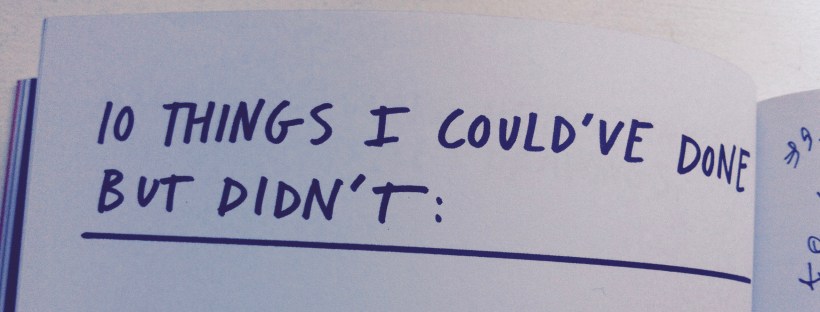
During the last session of Creative Rendezvous I included a prompt from Austin Kleon’s “Steal Like an Artist Journal”: “10 things I could’ve done, but didn’t”. My own immediate reaction was that I couldn’t come up with what to write, and managed to list three things. During our discussion, it became evident that actually this prompt can easily move into self-blame and regrets domain. This got me thinking what would be a more constructive approach instead?
Eventually I managed to complete the list and after analyzing the answers I came up with the following strategy how to deal with it, how to prevent self-blame and have a more positive outlook when evaluating the answers.
Divide your answers into four groups:
1. To celebrate – maybe it was actually good for you that some things on your list did not happen. For example, if you’re working on quitting smoking, then saying “I could’ve smoked a cigarette last night after that beer, but didn’t” is great, it’s an achievement – celebrate that, compliment yourself on it!
2. Still to celebrate (+/-) – the outcome generally is more on the positive side. For example, “I could’ve spend more time and finalize the article, but instead I went to bed early” or “Could’ve taken more photos during the session, but got totally engaged in the moment and forgot”. The issues mentioned in the “I could’ve done” part are “nice to have”, but overall outcome is still positive. The “didn’t” part has a positive quality to it, something positive, energizing, valuable happened instead. The “nice to have” part can be looked into further – is it something that you should work on or it’s ok as it is?
3. To act on – a group of issues that you would like to act upon, for example “I could’ve done more yoga”, “I could’ve listened to those classes I bought on Creative Live” and there is no continuation to it, there was nothing else with the positive outcome that you did instead. First of all, see how many of those you have in relation to the previous groups. Then weigh them. Do those things bring you closer to your dream, to your “true north”? Ask a follow up question: “If I spend some time doing this next week, will it bring me closer to my dream?” If it will, then that’s an item to act upon. And if not – it goes to the last group:
4. Not to pay attention to.
If still not sure where to start and which issue to choose to work with, then answer these questions for each item (inspired by one of the exercises in Julia Cameron’s book “Way of Artist”):
– Does it cost money or is it free?
– Expensive or cheap?
– Alone or with somebody?
– Job related?
– Physical risk?
– Fast-paced or slow?
– Mind, body, or spiritual?
This should help to make a decision – which is the issue that you would like to act on in the nearest future. Evaluate your calendar – how often can it happen, when exactly?
Schedule it in, make it happen and enjoy it!



 Creative Time Studio