
What we hear, what we say, what we experience: looking through a cultural lens
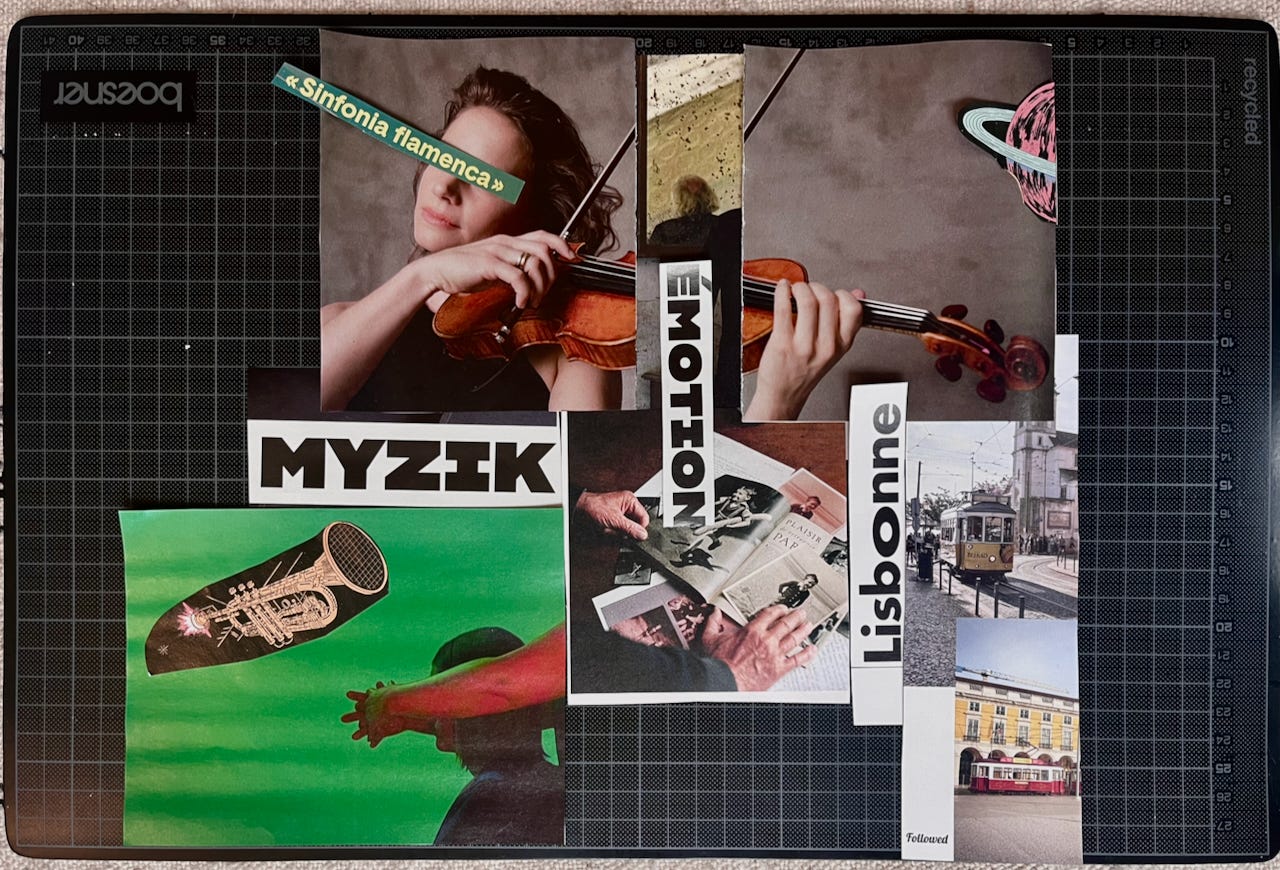
When I was teaching cross-cultural psychology in Denmark, I used to do this little experiment with my American students. I’d play them a fado song – I just needed to make sure no one spoke Portuguese. I would ask then: listen.. what do you hear? List the emotions that evoked in you by this piece..
Most of the time, students would describe the mood as rather upbeat. Which is interesting and there is research by my colleague, Nandini Chatterjee Singh and her colleagues showing that when we listen to music from outside our own culture, we tend to decode emotion primarily from the rhythm, the beat. The tonal structure, the melody – we don’t quite know what to do with those yet.. So the students heard the rhythm and went with it.
Then we would listen to the same song, but with the subtitles of the lyrics. And the responses were completely different. Fado as a form of music is characterized by mournful tunes and lyrics, often about the sea or the life of the poor, and infused with a sentiment of resignation, fatefulness and melancholia. This is loosely captured by the Portuguese word saudade. It doesn’t have an equivalent in English.
Saudade was once described as “the love that remains” after someone is gone. It is the recollection of feelings, experiences, places, events that once brought excitement, pleasure, well-being, which now triggers the senses and makes one live again. It can be described as an emptiness, like someone or something that should be there in a particular moment is missing, and you feel this absence.. But there is also joy in it, gratitude, tenderness for the fact that it existed at all.. Longing and joy in one word. Once the students had the lyrics, they could feel all of it. But it wasn’t something that resurfaced only by the music itself. Understanding the words added another dimension.
I ran the same experiment with students in India. Completely different story. From the very first take – no translation, no explanation – they listed everything. The longing, the sweetness, the grief, the gratitude. All of it, all at once. They didn’t understand Portuguese, obviously. But in Hindustani Classical Music, this kind of emotional complexity is built into the structure of the raga itself. It lives inside the scale. The Indian students had ears trained to hear what the American students needed words to access. This episode made me very curious about Hindustani Classical Music and was the triggering point for me to go deeper into this.
Anna Wierzbicka, the linguist, has been arguing for decades that the language you speak doesn’t just give you labels for your feelings. It shapes what feelings are available to you.
Take the English word “grief.” It carries a very specific scenario – something intense, relatively short-term, tied to death, understood as an interruption of normal life. Something to process and, ideally, move through. There’s a whole industry around it – grief counseling, stages of grief..
Russian has gore – which is closer to affliction, to suffering woven into the ordinary fabric of being alive. A thread, not a rupture.. There’s also bol’ (pain), stradanie (suffering), pechal’ (sorrow).. And toska, which is its own universe – a deep spiritual anguish, often without any specific cause. The Russian emotional landscape around loss is structured completely differently — more diffuse, more woven into ordinary existence.
French also has no word for grief. Wierzbicka makes this wonderful observation – Nussbaum, the philosopher, draws heavily on Proust to build her theory of grief as a universal human emotion. Yet Proust never used the word because it doesn’t exist in French. He wrote about douleur, souffrance, chagrin.
And then there’s the Polish tęsknota – very close to saudade.. Eva Hoffman describes it in her memoir Lost in Translation as something she was positively encouraged to feel in Cracow, through Romantic poetry and music, and then rigorously socialized out of in North America.
Even the word “happy” behaves differently across languages. In English, you can be quite happy, reasonably happy, happy with the arrangements. It’s an everyday word. The French heureux, the Russian sčastlivyj, the German glücklich – none of them work this way. They’re reserved for something exceptional, something rare.
What does it do to your emotional expectations when your language tells you happiness is ordinary? Or when it tells you happiness is extraordinary?
A really interesting question that Wierzbicka keeps coming back to: if bilingual people consistently say that having different emotion words in their languages changes the texture of their inner life – on what grounds can someone who has lived in only one language tell them they’re wrong?
In my practice I often work with clients who come from Russian-speaking families but choose to do therapy in English. They did their schooling in English, built careers in it, and it’s the language in which they learned to explain themselves to the world. It is also, often, a language that gives a certain distance.. It is easier to talk about difficult things in your second language without the ground giving way under you. The words carry the meaning but somehow don’t carry the full weight. Sometimes that distance is exactly what allows to approach something they couldn’t otherwise touch.
But then they start talking about childhood – about their time with grandparents in the summer house.. and Russian comes back. Unexpectedly.. I’ve watched people surprise themselves mid-sentence, suddenly in a language they hadn’t planned to use, saying something they didn’t know they were going to say.
Other clients – Danish, German, Iranian, Indian – come to me specifically to work in English because they are in a relationship with an international partner. English is the language of their home, their daily life as a couple. They want therapy in English because they need to bring what surfaces in the session back into the relationship, in the language the relationship actually lives in..
Some emotions are simply easier to approach in a language that isn’t your first. The second language gives a frame. A little air between you and the thing. In your mother tongue, certain feelings are pre-verbal, tangled in the body, older than reason.. That closeness can be a gift. But it can also be a trap. I’ve seen how it keeps people in situations, in relationships they know aren’t good for them – because the pull isn’t logical. It’s linguistic. It lives in the sound of a voice, the cadence of a phrase, the particular gravity of a word that has no translation.. And emotions that resurface only in that language.. At least that’s how I understand it so far..
What language does your inner life actually happen in? In what language(s) do you think? In what language(s) do you feel? In what language(s) do you dream?
What shifts when you try to speak about it in a different one?.. What opens up, and what gets lost?
I keep wondering about this, but I don’t think there’s a clear answer. But if these questions resonate with you, or if you find yourself navigating your emotional life across languages and cultures – I’d love to hear from you. And if you’d like to explore this in a more personal way, do reach out..
References:
Wierzbicka, A. (2003). Emotion and culture: arguing with Martha Nussbaum. Ethos, 31(4), 577-600.
https://anthrosource.onlinelibrary.wiley.com/doi/abs/10.1525/eth.2003.31.4.577
Midya, V., Valla, J., Bhide, A., & Chatterjee Singh, N. (2019). Cultural differences in the use of acoustic cues for musical emotion experience. PLOS ONE, 14(9), e0222380.
https://doi.org/10.1371/journal.pone.0222380
The fado song – from the beautiful film by Wim Winders about Lisbon, The Lisbon Story: Alfama by Madredeus

