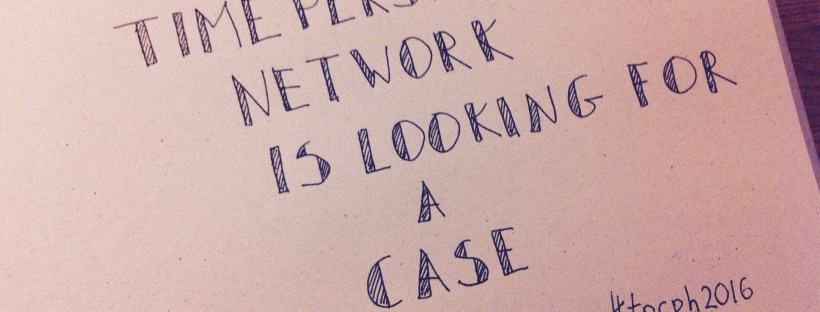
Time Perspective Network is looking for a case

We are a bunch of scientists who study time, we know a whole lot about waiting time, user experience of time, time across cultures, sustainability behaviors, teams and groups, and how they evolve in time, the vision and future scenarios, we apply temporal research in strategic innovation , designing apps that help to cope with chronic diseases, preventing suicide – maybe you have a case for us to work on during our Conference in Copenhagen this August?

We are in it together with local engineers, members of IDA – so it’s an interesting mix of people – psychologists and engineers and a bunch of artists as well! Please keep us busy!

We want to work on something challenging, interesting and useful! Know some one we should talk to? Please get in touch!

eventora_header

Temporal Matters Salon

This has been an exciting collaboration so far – between me, representing the International Time Perspective Network and the Celebrating Time, 3rd International Conference on Time Perspective and Creative Roots: Collective Urbanism.

For most part, very outside my comfort zone, but that is why I ventured on this adventure – to explore where and how the psychological theories about time and urbanism issues intersect.

So far we held two Salons at the Cafe Ved Buen. One talk was dedicated to Pace of Life and the other one – to chronotope. The more I read about the chronotope, the more I was getting inspired by this concept and its possible applications outside the literary studies.

You can see my prezi’s from both of the occasions and you’re most welcome to drop by next time! See the schedule and sign up on Eventbrite.

Temporal Matters Salon #1: Pace of Life

Temporal Matters Salon #2: Chronotope: the time-space

Temporal Matters Salon

First issue of Time Talks

The online journal of our International Time Perspective Network, Time Talks, is live! The first issue is featuring interview with Jonte Vowinckel, who talks about his views on time, time perspective and role of present.

The interview was carried out by Elena Kazakina and Ksenia Chistopolskaya, members of the Health and Clinical Issues thematic group, illustrated by Radhika Chitalia from Handmade by Radhika.

Hope you’ll find it interesting! Would be happy to know your thoughts about it!

Find the interview here.

New article: Personal time perceptions and their impact on cooperation across nations

our project, inspired by the summer school on social simulations and complex systems in 2009, has finally produced the results! it’s been a long process and I’m so thankful to everyone who participated in it one way or another! science is always a collaborative effort!

you can find our paper, Simulating Irrational Human Behavior to Prevent Resource Depletion in PLOS ONE


ZTPI across cultures project: FAQ

I am happy with the response rate to our second call for collaborators to our joint research project on time perspective!

We hope to be joined by:

Shanmukh Kamble – India

Elizabeth Temple – Australia

Elena Mitu – Romania

Boštjan Bajec, Mojca Pavsic  – Slovenia

Maria Chayinskaya – Italy

Tim Nestik – Russia

Anna Karcz – Poland

Paulo Dias – Portugal

Gábor Orosz – Hungary

Cristián Oyanadel – Chile

Kiyoshi Takahashi – Japan

Yu-Jing Gao – ROC

Aleksandrs Kolesovs – Latvia

Oksana Senyk – Ukraine

Daiva Daukantaite – Sweden

Jameson K. Hirsch – USA

Jinkook Tak – Korea


Here I would like to summarize questions that have been reoccurring.

Addressing the concerns arising from the people involved in the first stage that was launched in 2009:

This is a continuation of our initial project and you don’t need to submit your data once again. According to our agreement we aim to report results of the study in 3 publications. Currently we have submitted the first one, so there are two more to go.

Future Negative scale:

If you have validated the Future Negative scale (developed by Grazia Carelli, Britt Wiberg and Marie Wiberg at Umea University, Sweden) and used it in your research you’re welcome to submit it as well. Please create a separate XLS file for this particular scale. It is not yet available in all languages, but it’s coming. I think we’ll report the cross-cultural results for this scale where it will be possible.

Some more info for the newcomers:

The projects aims to collect the data into collaborative project from those who already have the data (usually from the country validation study). We aim to produce two more articles with this initiative.

The sample we are interested in should include at least 200 participants aged 18+. Online collection is fine.

The deadline for submitting your data – 31.12.2012.

Data should be in the format according to our instructions (contact me if you haven’t received the templates) and should be accompanied by:

1) file with your country keying

2) your country ZTPI version and it’s back translation into English

3) Information file

Please include a publication (if any) that reports the adaptation of your country version. If you do not have a publication yet, please provide us with the basic info on the validation study including with procedure you used when developing the scale in your language (translation-back translation / bilingual committee approach / etc.).

Addressing those who are in the process of reporting your validation results and a reoccurring question on the following paragraph in the Agreement:

“The following publications by participants, based on the dataset mentioned at article 2, are allowed only after the realization of these three central publications, which is assessed by the formal acceptance of submitted manuscripts by the journal“.

The indication “based on the dataset mentioned at article 2″ is important. It means that agreement regulates only the using of the full dataset, and that the only cross-cultural comparisons forbidden by the agreement before the 3 main publications are those based on the full dataset (gathering all data provided internationally), and those using sample from this dataset not collected directly and without authors permission.

So, you are absolutly free to use your own sample as you want, and to collect by yourself other data to perform your own cross-cultural comparisons (what can be really interesting and useful to further our understanding of cultural dimension of TP). The objective of the agreement is to forbid unfair use of the full dataset, given that contributors shared their data with us for a particular and identified purpose. We don’t want someone who had access to the data to use it for personal publications. It is a way to protect data, not to restrict scientific  liberty and autonomy for contributors. This agreement is a bit harsh to ensure for clarity and fairness.

I hope I covered most of the questions! I will be posting more info on the project while it will be developing. Please keep an eye on this page for now (our website is still being recovered). You can also follow me and advancements of the project on LinkedIn, ResearchGate or Academia.
Invitation to ZTPI cross-cultural research project

It has been a great pleasure to meet some people from the Network this September in Coimbra and got to know about the research you’re doing with the ZTPI scale! Many of you know that we have started our joint cross-cultural project in 2008 and at the moment we have 24 countries participating in it.

We have an opportunity at the moment to include new collaborators into the project. If you have validated (or used) ZTPI (the full scale of 56 items) in your country and you’re still not part of our project, we’d really would love to hear from you!

We established equivalence for the five-factor structure and invariance of 36 items of the scale. On the next stage of the project we aim to make cross-cultural comparisons of time perspectives and relate them to the variety of socio-economic indicators (such as, Human Development Index, Hofstede’s Dimensions of Culture, etc.). The project in general is coordinated by me, Anna Sircova, Nicolas Fieulaine (Lyon University), Evgeny Osin (HSE, Russia), Taciano Milfont (Victoria University of Wellington, New Zealand), Altinay Erginbilgic (Canada) and is supervised by prof. Zimbardo (Stanford University) and prof. van de Vijver (Tilburg University).

Please contact me, Evgeny or Nicolas before end of November 2012 if you’re interested to take part in this exciting endeavor!

Please contact me for more detailed info, guidelines for the data presentation and the agreement between collaborators in this project.

We would like to have the data in our proposed format by the end of the year, end of December 2012.

We didn’t have the pleasure to meet everyone personally yet, and unfortunately our website – where you could find some information about us and our projects and activities is still down (someone has hacked it and we are still working on restoring it – we’d love to hear from you if you know how to fix it and make it alive again!!!). However, you can still visit the conference website.

We also have a mailing list for people working in the field of TP – please let me know if you’d like to join it and if you’re not still in it! http://groups.google.com/group/tp-world

We also would like to invite you to our next TP Conference which will take place in 2014 in Poland – more information will come in due time, but mark your calendars! : )

Looking forward to hearing from you!

With best regards and great interest,

Anna