The art of doing less – observations

Some observations I made while following the online course on CreativeLive on the Art of Less Doing with Ari Meisel.

People get stressed by how things work. Some other people develop an app / technique to lower that stress. Something that supposedly helps you out, makes you more productive, but then there are so many solutions to the same problem that we actually need a guide, who would review all those available solutions, test them out and pick the best for us. He/she figured it out for themselves, fine-tuned to address the challenges they face and then it works for them. Would it work for us? We don’t know, but we buy the guide anyway.

What I learned from the course:

  • if you have “what” to share, the “how” will follow
  • ideas of setting up an email based course
  • organization, like creativity, needs limits and will-power

What I will act on:

  • have a heard a few times about pomodoro technique by now – will try it out
  • restructure my DropBox

Significance of impact factor

The best news ever, in my opinion, came in unexpectedly from from Quora forum regarding this issue. Someone asked “What is the significance of the impact factor?” and a very interesting answer came in from W.Gunn:

It has little significance anymore, except among those who haven’t been paying attention for the past 10 years or so. There  is international consensus by bibliometricians on the idea that the IF  should not be used by researchers. Please read the Leiden Manifesto Bibliometrics: The Leiden Manifesto for research metrics and the Declaration on Research Assessment San Francisco Declaration on Research Assessment (DORA)

The  best thing to do, if you’re looking for a journal in which to publish,  is to ask an academic librarian in your field of study. You can also ask  a senior colleague which are the respected journals in the field, but  if they start talking about Impact Factor, give them a copy of the above  referenced materials and go ask someone else.

Even the countries which used to include IF in assessment exercises which determine grant allocation are now moving away from using the metric.

I hope it will change the picture very soon!

3rd International Conference on Time Perspective | 1st Announcement

Do you have an exciting new breakthrough that you would like to share on an international platform? It is our great pleasure to invite you to participate in the 3rd International Conference on Time Perspective!

When: 15-19 August 2016
Where: Copenhagen, Denmark

International Time Perspective Network has been around for 7 years with more than 250 specialists from 40+ different countries affiliated with the Network, this is your chance to add your voice to a large conversation benefiting the greater good!

We dedicate this event to celebration of the concept of time, be it even a persisting illusion. We would like to invite you on this journey with us – to explore the nature of time, to get inspiration and to inspire in return.

We have a great line-up of speakers, who will cover many diverse aspects of the concept of time: psychologists, physicists, futurists, philosophers, designers, innovations consultants and even a science comedian!

Christophe Bureau (France)
Toshiaki Shirai (Japan)
Gerben Westerhof (Netherlands)
P.A. (Patrick) van der Duin (Netherlands)
Michelle Bastian (UK)
Sian Lindley (UK)
Helen Pilcher (UK)
Yaacov Trope (USA)
Sheldon Solomon (USA)
Robert Levine (USA)
and of course, Philip Zimbardo (USA)

In addition to the key-note presentations, the conference will host a number of parallel sessions in variety of formats. Thus we invite submissions on topics that touch upon the exploration the concept of time and time perspective.

As a reference point we include the following key-word cloud:
time, temporality, time perspective (past, present, future, balanced, unbalanced, etc), temporal horizon, past, present, future, life-space, time zone, temporal frame, image of the future, future scenarios, planning (organizational, career, etc.), time management, sense of time, understanding of time, tempo, rhythm, time perception, time attitude, future anxiety, transcendental future, eudaimonic present, presence, sustaining time, experience of time, innovation, well-being, etc.

However, your submissions should not be limited to them. We include those as a starting point.

We welcome contributions in a variety of formats: Idea Labs, workshops, art installation (music, sculptures, visual arts, performances, movie screening with a follow-up debate, work / project groups, presentations, discussion tables / brainstorm groups, debates (can be in the tag team format / polarized opinions format / etc. ), live research experiments, and others.

Your submissions should be in line with the overall vision and goals for the Conference:
We would like it to be fun, engaging, interactive, cross-disciplinary and frame shifting event. We think that the time has come to reinvent the format of the conferences.
We would like it to be a forum, where researchers / academics, entrepreneurs, business people, policy makers and general public meet. We would like it to be a platform where people could put together their competencies and work on finding a solution for a particular problem together. We would like to start a dialogue on different levels.

The Conference in Copenhagen aims to:

  • create dialogue across the disciplines and approaches to time and temporality
  • create a space / platform where academia, innovators, entrepreneurs, policy makers, business people and general public meet
  • create inspiring environment where different real-life challenges can find their solutions
  • apply TP theory to solving real-life problems
  • try out different forms of presentations: more engaging, fun, inspiring beyond the content, aimed to be with and for society
  • live up to our motto: “Diversity of Approaches, Unity of Passion” – to think and act across the disciplines

The organizing committee will mainly concentrate on curating three directions of the Conference: innovation, sustainability and well-being. Feel free to propose activities in other directions!

Important dates:

Submissions and registration will open in late August – we will keep you posted.

Pre-arranged symposia / round tables / debates: 18 October 2015
Early Abstract submission: 15 November 2015
Early bird registration: 17 January 2016
Regular Abstract submission: 25 January 2016
Regular registration: 15 March 2016

Selected papers will be given a possibility to be considered for publication in Time & Society.

Our partners:

We are extremely happy to present some of the partners, who are supporting the Conference already:

Danish Institute for Study Abroad, Denmark
University of Lyon, Social Psychology Group (GRePS), France
Alternative Copenhagen, Denmark
Magnify Money, USA
Liveart.dk, Denmark

More information is on the draft website of the Conference
Follow us on Facebook, LinkedIn or Twitter

Download the call for participation.

Warm welcome to Copenhagen!

Anna, Nicolas, Wessel, Elisenda, Oksana, Lika, Natalie, Antanas, Jonte, James, Mia and Lisa

Временная перспектива – русско-язычные исследования

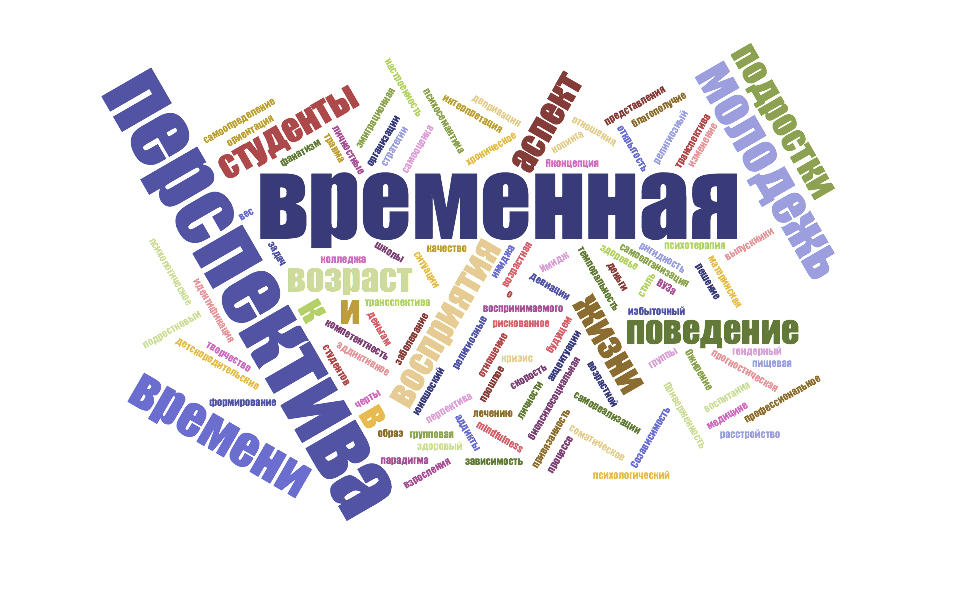
О чем же проводят исследования наши русско-язычные коллеги все эти годы? Я давно задавалась этим вопросом. И может есть какие-то тенденции, “мода” на определенные темы? Мы пытались как-то собирать сведения об исследованиях, ведь нам, разработчикам методики, это очень интересно на самом деле. Автоматизировали мы это только в 2013 году, до предыдущих лет не знаю, когда руки дойдут..

Вот, какая у нас картинка сложилась:

2013:

index-2013


2014:

index-2014

2015:

первая половина года

index-2015

First issue of Time Talks

The online journal of our International Time Perspective Network, Time Talks, is live! The first issue is featuring interview with Jonte Vowinckel, who talks about his views on time, time perspective and role of present.

The interview was carried out by Elena Kazakina and Ksenia Chistopolskaya, members of the Health and Clinical Issues thematic group, illustrated by Radhika Chitalia from Handmade by Radhika.

Hope you’ll find it interesting! Would be happy to know your thoughts about it!

Find the interview here.

Human organisations..

Human organisations are not at all like mechanisms. They are made up of living people who are driven by feelings and motives and relationships. Organisational charts show you the hierarchy, but they don’t capture how the organisation feels or how it really works. The fact is that human organisations and communities are not like the mechanisms: they are much more like organisms.

– Ken Robinson: The Element: How Finding Your Passion Changes Everything

Slides from the workshop on culture shock at International House

Dear all,

it’s been a pleasure to seeing such a diverse and enthusiastic group at the Workshop! Hopefully you found something valuable for you at this event! Please let Kari know what you thought of the event, so that we can try to make it better next time!

You can find the slides here in PDF format. And here is live presentation, if you want to see the youtube clips again 🙂

Cheers,

Anna

ключи от методики Зимбардо

Мне пишут уже много лет запросы на ключи к нашей адаптации методики Зимбардо на русский язык. Надо было их как-то сразу фиксировать – иногда приходят такие интересные письма, но я их сейчас уже не могу найти ))

Вот из свежепришедшего (оригинальное правописание сохранено):

здраствуте. говорят у вас ключи к методике Зибардо. пришлите если можно.

Здравствучте Анна, провели  данную методику в университете, а ключей не можем найти! Заранее Вам Спасибо!

Особенно порадовало меня:

Здравствуйте, подскажите, пожалуйста, каким образом производится обработка результатов методики?

Какой именно методики …

Вообще, практически никто уже не подписывается. Посмотрела некоторые из более ранних запросов – обычно более длинные были преамбулы, представлялись, рассказывали немного о себе, кто, что делает, откуда, зачем методика и т.д.

Здравствуйте. Меня зовут … . Я студентка пятого курса специальности “психология”. В своей дипломной работе планирую использование опросника временной перспективы личности Ф.Зимбардо (русская версия). Мне необходимы ключи и алгоритм обработки. Заранее спасибо.

Иногда более креативно:

Здравствуйте, Анна!
Не могли бы Вы прислать ключи к методике и алгоритм обработки результатов, пожалуйста. Пишу диплом, очень хочется, что бы с Вашей помощью он стал еще более интересным и достойным!
Заранее благодарю.
…, студентка специальности психология, ВАГС, г. Волгоград.

Вспомнился мне семинар по теме, который мы делали в 2008 году про культуру профессионального общения. Нашла даже слайды с него – может пригодятся кому ))

Workshop: Cross-Cultural Mobility & Coping Strategies | International House

International House Copenhagen invited me to hold a workshop that deals with the issue of culture shock.

The event takes place:  Thursday 28th May from 17.00 – 20.00

Participation is free of charge but there is a limited number of seats and it is open for participants of the following programs: Copenhagen Career Program, Copenhagen Host Program and Copenhagen University.

First come, first served.

Invitation

Where:

Gyldenløvesgade 11
1600 Copenhagen V