Participating in the Danish Research Festival

In the week 17, or from April 25 to May 1, there will be Danish Research Festival running across the country and this year I’ll be part of it!

The organizers say that “the festival programme has about 500 different events in more than 100 cities all over the country and every year more than 65,000 guests visit the festival.” It is ran every year and it is organized by Ministry of Higher Education and Science.

It seems like the main idea of the Festival is to bring science closer to general public. Sounds like fun! I’ll be exploring different events during the week and will keep you updated on my favorites from the proposed programme.

If you are in Copenhagen and you’re interested in psychology of time, please join me!

Psychology of time: Before, after and in-between

April 28th, 19:00 to 21:00 at Rantzausgade 34

Please register here, since the places are limited.

This talk aims to introduce you to the exciting topic of psychological time.

The different roles time plays in our everyday life, how it impacts what we do and how, how the tempo of a city has an impact of our health and how to find a temporal balance will be explored during the talk.

We will also talk about temporal aspects of groups and cultures and how those influence cross-cultural communication and sustainability issues.

6

Creative flow as a resource

May 1st, 12:00 to 14:00 at Rantzausgade 34

Please register here, since the places are limited.

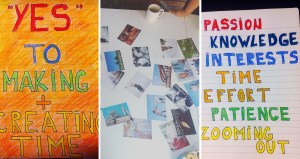
This workshop is designed to serve as a window into a different reality, a few hours just for yourself, away from usual stress, uncertainties and routines. An opportunity to zoom out, to do something different or something long forgotten, but enjoyable and invigorating.

It is time to get together with your inner creative and a few other like minded people and do something fun and inspiring.

It is time to take a break, breathe, be with yourself and dissolve in your dreams and then continue with new energy and focus.

It is time to stop waiting for the muse, we’ll start without her, but she’ll join us anyway.

It is time to create and discover!
2


Making connects the hand, eye and brain in a very special way

An interesting article about transforming and empowering role of creating by Paula Briggs, director of AccessArt:

Creating is not just a ‘nice’ activity; it transforms, connects and empowers

We don’t need to make to entertain ourselves: in the past we might have kept our hands and eyes busy with making in our spare time, but now we occupy ourselves through binary code.

I hope that more of us will choose making and creating instead of the ‘binary code’!

Last days at Prøvestenen – wanna be a model?

Dear friends,

there are always times that something comes to an end, but of course something else starts at the same time.
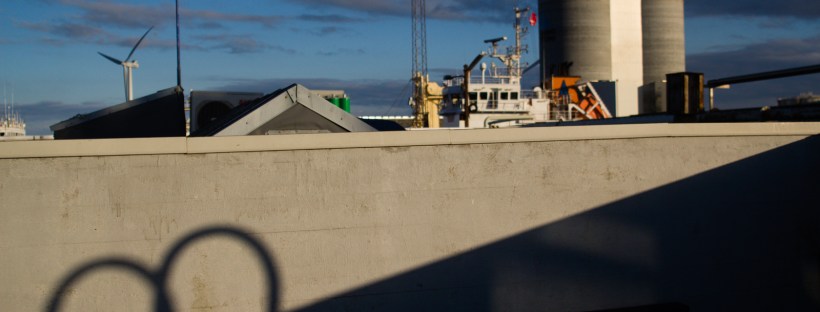
I invite you to visit me at my studio in Prøvestenen for the last time – we have to move out by April 1.

I’d be happy if you will help me to capture this special place in some series of images – and if you can also help me to pack and move some of the things – that would be great as well. But most importantly I just want to use the space for the fullest while it lasts. It offers really interesting backdrops and such. So if you ever dreamed to be a model – I would be really happy to work with you!

You’ll get to see a very special place in Copenhagen and you’ll get some bizzare photos taken at the same time.

Please call me – 71437363 – I won’t have much internet access while I’m there.

Hope to see you!

The essence of a place

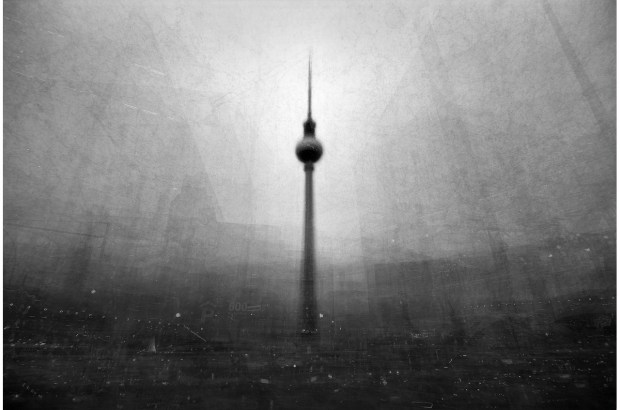
A very interesting find for me – the works of a German photographer Frank Machalowski.

1

Multiexpo 100 | Frank Machalowski

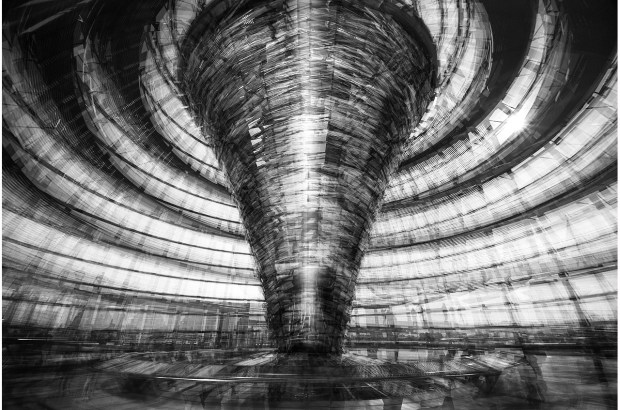
Since my talk on chronotope, the notion of time-space and its application in the city scape, I’ve been paying more attention to how time and space are intertwined in the urban setting. Working with the geometrical figures inspired by Chillida’s work has also made an impact on how I perceive the geometry in everyday setting. I particularly like the image below, where you can see the geometrical forms ‘floating’ in the air.

31

Multiexpo | Frank Machalowski

These interesting series by Frank Machalowski tapped into something I wonder about these days – the interconnections of places in time and the geometry of it. Am not sure how to phrase it even.. I guess it will come later on..

18

Multiexpo | Frank Machalowski

I really enjoyed Frank’s approach to a place – to take multiple exposures of it, to capture the surrounding context, but make it subtle, to keep only the essence and mute down a bit the everyday buzz that surrounds it. It’s like taking a perspective of that building or place on what’s happening around it. To see what emanates from the building. It especially caught my attention, since I just came back from Berlin and just being in those spaces myself made me more attuned to these series.

Should load some film into my old Zenit and try this out..

17

Multiexpo | Frank Machalowski

6 countries, 11 cities, 20 addresses

Did the calculations the other day – some random facts in my biography – listed all the places that I have lived, well, the ones that I could remember, and that’s what came about: 6 countries, 11 cities, 20 addresses…

“Places I’ve done time”, as William Saroyan puts it.. So here are my places, where I have done some time:

  1. Latvia: Riga (4 addresses), Kesterciems, Jurmala, Kadaga
  2. USA: Moses Lake, WA; San Jose area, CA (2 addresses)
  3. Russia: Chelyabinsk, Moscow (5 addresses)
  4. Spain: Granada
  5. Sweden: Umeå (2 addresses)
  6. Denmark: Copenhagen

I keep on thinking it would be nice to finalize some of my photo projects that are linked to those places. One day.. One day..

It actually feels a bit strange that it’s been 3,5 years now and I haven’t moved anywhere… I have to move my studio by April 1 though, but that’s a different story…

Time Perspective Network is looking for a case

We are a bunch of scientists who study time, we know a whole lot about waiting time, user experience of time, time across cultures, sustainability behaviors, teams and groups, and how they evolve in time, the vision and future scenarios, we apply temporal research in strategic innovation , designing apps that help to cope with chronic diseases, preventing suicide – maybe you have a case for us to work on during our Conference in Copenhagen this August?

We are in it together with local engineers, members of IDA – so it’s an interesting mix of people – psychologists and engineers and a bunch of artists as well! Please keep us busy!

We want to work on something challenging, interesting and useful! Know some one we should talk to? Please get in touch!

eventora_header

A few thoughts on open access and open science

I have recently stumbled upon this article by Simon Oxenham: Meet the Robin Hood of Science

We should all think before publishing papers:

“Researchers and universities don’t earn a single penny from the fees charged by publishers such as Elsevier for accepting their work, while Elsevier has an annual income over a billion U.S. dollars. Elbakyan explains: “I would also like to mention that Elsevier is not a creator of these papers. All papers on their website are written by researchers, and researchers do not receive money from what Elsevier collects. That is very different from the music or movie industry, where creators receive money from each copy sold. But the economics of research papers is very different. Authors of these papers do not receive money. Why would they send their work to Elsevier then? They feel pressured to do this, because Elsevier is an owner of so-called “high-impact” journals. If a researcher wants to be recognized, make a career — he or she needs to have publications in such journals.”

Inspiration: Eduardo Chillida

I have stumbled upon Marion Deuchars’ Draw Paint Print like the Great Artists in Glyptoteket’s book shop I believe. I really liked it since from the quick look it had a variety of different techniques in it. And I’ve been exploring the book and the artists featured in it since then.

This time I was completely absorbed by a whole new world that has opened up for me – the world of Eduardo Chillida (1924-2002). I must say that I can’t remember if I heard anything about him until now, I probably had, but it didn’t really stay in my memory. I am very thankful to Marion for including this artist in her book! Not only I had loads of fun first coloring the proposed shapes in the book and later trying out my own cut outs, but also I was mesmerized by Eduardo’s work.

Here are a few examples, but a simple google search will reveal a whole new universe.

I’ve read what I could find on internet about him. A Spanish Basque and mostly known for his monumental sculptures. I will explore what the local library has to offer to get to know more about him and his work. From a very quick look I was struck by two of his projects in particular.

The Basque Liberties Plaza, Vitoria-Gasteiz, Araba, Spain – I would really like to go there and experience it.

Monument to Tolerance, Fuerteventura

Made by Arup in Mount Tindaya on Fuerteventura, one of the Canary Islands. From the photos I’ve found I somehow started to think about the Fifth Element movie… It definitely goes on my “wish-to-visit” list. Although I’m not sure if the island itself has any authentic places left or it is all devastated by the tourist industry…

Just returning from the study tour with DIS students to Berlin made me very aware of the effects architecture can have. And “Chillida’s original idea was for visitors to experience the immensity of the space” made me very curious about this piece.

The wikipedia also mentions an interesting encounter between Chillida and Heidegger: “Heidegger wrote: “We would have to learn to recognize that things themselves are places and do not merely belong to a place,” and that sculpture is thereby “…the embodiment of places.”

277N09157_7D5LG

I was hoping to find some kind trace of this dialogue in print. However, not much is available in English. There is the original book in German and actually a translation of it in Danish. I’ll look around more, maybe I can find it in in some other language that I know better, but for now it goes into my “to read” list.

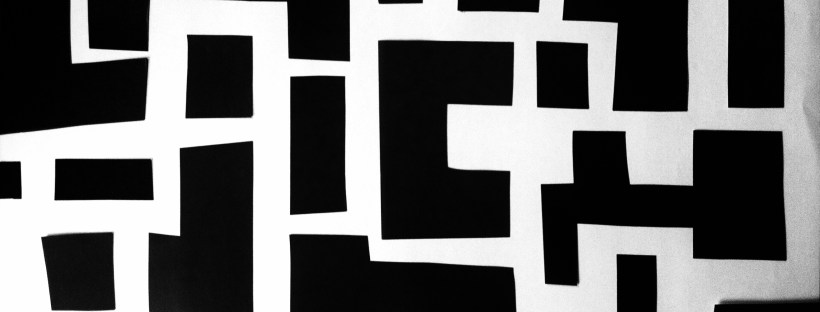
Here are some of my exercises on the Eduardo Chillida theme:

I’m currently reading Saramago’s The Cave and am trying to imagine the Center that he describes in the book and I think my further cutouts are really somehow intertwined with the book..

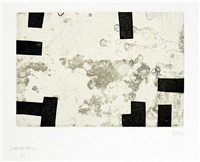
Then I tried to explore how Chillida was working more with the white space:

eduardo-chillida-enparantza-i

and here is my take on it:

IMG_2873

but it was somehow difficult for me, then I rearranged the cutouts and spontaneously this version came out, which I still don’t know how it should be – vertical or horizontal..

IMG_2879 (1)


IMG_2879 (2)